
Driving a Federal Evolution of Stability & Growth
1. The Case for a UK Federation
Similarly to the LibDem Party, we believe that federalisation is the best way forward for the UK. However, our proposals are different, more specific, more developed and more integrated within a broader framework of both political and taxation system changes. Changes aimed to spread equal opportunity & wealth. strengthen national unity under a mutually-beneficial written constitution guaranteeing fair and equal treatment for every State.
The UK’s Treasury currently pays centrally-allocated grants to Scotland and Wales of around £65 billion annually. This is more than the current UK Defence Budget and about a third of what it costs to run the English NHS.
Our proposals would replace these grants with a transparent system – in which states raise their own revenue, whilst all sharing national prosperity through a cross-state equalisation fund – driven by a Hybrid Income Tax.
UK Federalisation would therefore strengthen the democratic accountability of government, eliminate dependence on Westminster grants, and create a fairer and more sustainable constitutional settlement for every part of the United Kingdom. A better constitutional alternative to Scottish and Welsh independence – with less risk to economies, defence, currency and trade.
2. States & Constituencies
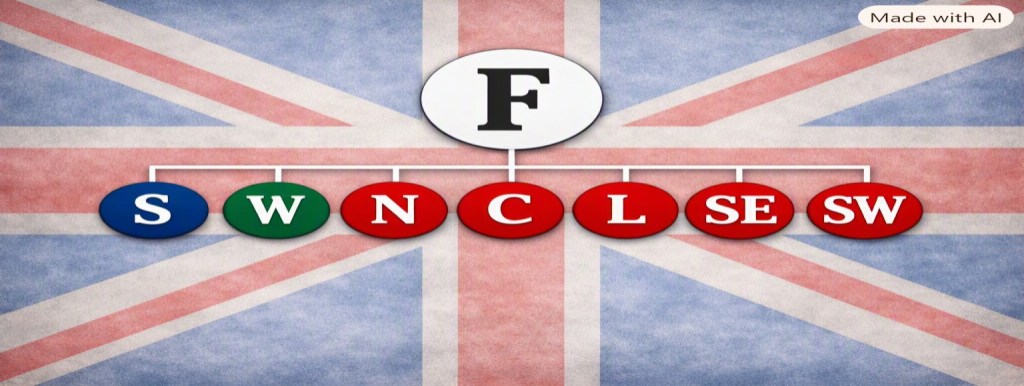
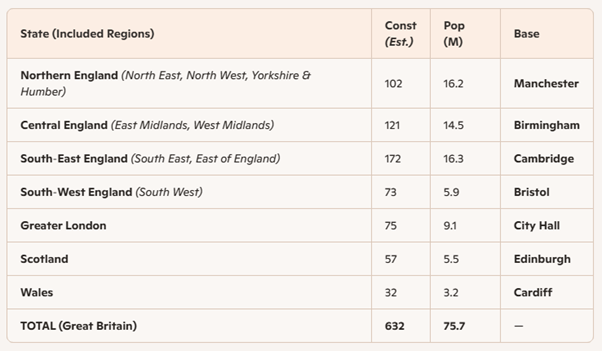
The proposed UK 7 State structure is shown below (the number of constituencies in a State estimated in some cases). Northern Ireland would initially lie outside the Federation – but would later become an 8th State – were its citizens so to choose. The average-size British State population is about 11 Million – about twice as big as the average-size German State.
3. Generic Government Structure (Unified Democracy)
Within the UK Federation, Elections, and Formation of Policy (both at Federal and State levels) are based on a generic system of Unified Democracy – delivering substantially more Power to The People. This is a Three-Tier structure, each Tier requiring the confidence of the one below it to hold it in place. This is described later (Page 3) but in summary, is of 3 Tiers :
- The Executive. This Tier is led by the Elected Cabinet, together with supporting Offices. It sets the agenda and policy objectives (in accordance the proposals citizens voted for), overseas the smooth, ethical and efficient running of Government. It drives top-down policy only in times of emergency (such as for pandemics and warfare).
- The Policy Council. This Tier consists of Teams consisting of an equal number of electorally-proportionate Cross-Party MPs and appointed Sector Representatives. These teams (called “Sector Management Groups”) competitively debate and draft Policy to meet objectives set, budgeted and coordinated by the Executive.
- The Legislature (House of Commons at the Federal Level). This Tier consists of MPs that inform the Policy Council of Constituent views and needs – and debate and vote for its draft polices towards Law.
4. Election Principles
Elections are designed for strategic continuity on the one hand – whilst avoiding being stuck with an ineffective Leader or Cabinet on the other. They are therefore held at variable intervals (of 2 – 7 years), and of two types – State Elections (independently held by each State) and Federal Elections (for the Westminster Executive Level). As today, Byelections are held within States when current MPs vacate their particular Constituencies.
To service the UK Federal Structure, there are two types of MPs:
- State MPs (simply called “MPs”) elected by each State. A total of 632 across the Federation as a whole (the same as at present) – one representing each Constituency in the State’s Legislature.
- Federation MPs (called “FMPs”) also elected by each State. These attend the Cental Federal Government (The House of Commons and Policy Council in Westminster). In total there are 294 FMPs – divided proportionately across States (an average of 42 FMPs per State)
5. State Governance & Elections
5.1 State Governance Structure
Each State Government is led by the Party with the Highest Popular Vote – its Leader becoming the First Minister. His/her Cabinet consists of a core team of 12 Secretaries – each heading a Particular State Department from a policy perspective – these being:
(1) Health & Social Care, (2) Education, (3) Transport, (4) Housing & Communities (5) Police & Public Safety, (6) State Civil Law, Justice & Prisons (7) Environment, Food & Rural Affairs, (8) Business, Trade & Innovation, (9) Welfare & Employment (10) Culture, Leisure & Sport, (11) Technology & Communications (12) Treasury & Fiscal Policy.
5.2 State Elections
State Elections are held independently, each individual State deciding when an Election is necessary. This occurs when either:
- After 2 years in office, the First Minister or Cabinet has lost the confidence of the State’s Policy Council.
- The State’s First Minister steps down.
- 7 Years have passed since the previous State Election.
Prior to each State Election, The Leader of a National Party wishing to field one or more Candidates within a particular State nominates one of his/her party’s Candidate MPs as Party Leader for that State. If that Candidate is not elected, then the elected MP achieving highest percentage of the Party’s vote in their Constituency becomes the State’s Party Leader instead.
The Leader of a National Party is only permitted to stand personally if his/her Party is not yet represented in the UK Federation by a Federal MP (because he/she normally only attends the Westminster Government in that role).
Voting is done in exactly the same way as for the traditional Westminster System -electing a Party or Independent MP for the State’s Legislature.
The State’s Policy Council is then resourced from these elected MPs – assigned electorally-proportionately across the State’s 12 Sector Management Groups – in accordance with the New Executive’s Policy Agenda (described further on Page 4 for “Policy Formation”)
Federal MPs (for attending the House of Commons) are selected from those Candidates that achieved the highest percentage of their Party’s vote in their particular State Constituency -whether or not elected as State MPs.
For example (for SE England – 172 Constituencies represented by 80 FMPs): if the Greens won 10% of the Vote (17 MP Seats), they would appoint 8 FMPs (10% of the State’s 80 FMPs). Their FMPs that were also elected as State MPs (likely most), would attend both the SE England State Legislature and the Federal Legislature (House of Commons) as necessary.
A State Election therefore has the potential to change the power-balance of the Federal Policy Council – possibly triggering a Federal Election.
6. Federal Governance & Elections
6.1 Federal Governance Structure
The UK Federal Governments Executive is formed by the Party with the Highest Weighted Federal Vote across the UK Federation as a whole (6.2). The Leader of that Political Party being the Prime Minister. His/her Cabinet consists of a core team of 12 Ministers – each Minister heading a Particular Federal Department from a policy perspective – these including:
(1) Citizenship & Immigration, (2) Foreign Affairs, (3) Fiscal Policy (Non-Personal Taxation & Budgetary Control) (4) Justice & Prison Infrastructure, (5) Agriculture, Water, Rivers & Coasts Policies & Planning, (6) Healthcare & Food Standards, (7) Socialcare Standards, (8) Education Standards, (9) Energy Infrastructure, (10) Transport Infrastructure, (11) Technology Standards & Infrastructure, (12) Defence (under special security arrangements).
6.2 Federal Elections
Similarly to State Elections, Federal Elections (for the UK as a whole) are held when either:
- After 2 years in office, the Prime Minister or Cabinet has lost the confidence of the Federal Policy Council.
- The Prime Minister steps down.
- 7 Years have passed since the previous Federal Election.
Voting in done by means of a different voting slip as the one used for State Elections. So, if the timing of a State Election and Federal Election coincide, then voters would use both slips (assuming they wish to vote in both).
Voting is performed by indicating the voter’s choice from a list of those Political Parties from which it has already elected its Federal MPs (5.2 above).
So, using the same example as for SE England (with 80 assigned FMPs):
If those FMPs had been elected as follows : Labour 40, Conservative 16, Lib-Dems 10, Greens 8, Reform-UK 6 – then the State’s voters would have a choice between those 5 Parties. Where a vote for Labour would have a weighting of 40, a Vote for the Conservatives a weighting of 16, and so on.
The Political Party with the highest weighted Federal Vote across the UK Federation as a whole then becomes elected to lead the Federal Executive – leaving the FMPs in the Federal Legislature and Policy Council unaffected, (but with the Policy Council under the control of the new Executive).
7 – Constitutional Impacts
The new Federal Governance Structure carries with it a number of obvious constitutional impacts. For example, those affecting The Monarchy, The Devolution Status of Scotland and Wales, The House of Lords, the Greater London Authority, Local Government and Regional Mayoralties. These impacts are described separately (for their necessary inclusion wit the Programme Transition Plan) – together with its Global Impacts (Page 5).

